What a crazy week! My co-worker berated me for not being what she requested: a "deaf" volunteer with a capital "D". Namely one who only signed and didn't wear hearing aids, namely one who was exactly like the deaf children of Uganda. Really...any foreigner who only signed and didn't speak would not be *exactly* like the deaf children here. Apparently, I've "undone" all her hard work in getting the parents to realize that their children will not benefit form hearing aids or speech therapy (no money for either). They've been calling and asking why I didn't come with the necessary "equipment". So heartbreaking! I get her point, but there are ways to solve this dilemma through educational meetings, fundraising, and more one-on-one time with individual families. Frankly, I think my co-worker needs to have her baby and take a lot of time off. So...there's a challenge for next week.
In addition to fundraising for Silent Voices, I'm going to work PT with Beacon of Hope (an orphanage that caters to children with PTSD) and Butabika Psychiatric Hospital in Kampala. One week a month I'll be up in Mukono, about eight hours from Bushenyi. More on this later -- off to training and then Lake Mburo for a weekend of birding!
Showing posts with label silent voices. Show all posts
Showing posts with label silent voices. Show all posts
Friday, July 24, 2009

Sunday, July 19, 2009
I’m still figuring out my goals and projects for the five months I’m here…things move very slowly in Uganda. One meeting can take an entire day…depends on how far the locals have to walk to get to the meeting place and how well they understand English. At yesterday’s meeting with the director of the Disability Rights Fund (from Boston!), I realized the focus needs to shift from the parents to the children. My co-worker Natalie, the Dutch founder of Silent Voices, wants to keep the focus on the parents (because she thinks the parents can educate the children), but DRF probably won’t continue funding SV if the focus doesn’t shift to teaching the deaf kids how to advocate for their rights. Also, the children tend to know more English than the parents. Natalie seemed annoyed by this, but couldn’t say anything because she obviously wants the money for next quarter…quite frankly, I think she’s tired of being in Uganda. Ten years is a long time, especially when you have four kids and another on the way. She’s always cranky and negative (good thing this blog is private!). She told me last week I was like all the other Americans she’s met, “loud and flamboyant”. Haha!! Thus far Silent Voices has focused on educating and teaching the parents about deafness, sign language, etc. Good things, of course – the parents are important members of the village. But the children need more sign instruction, the children should be telling the elders what they need and want. And eventually (hopefully??) the deaf children will want to make their own life. The most difficult part of the meeting was teaching the parents about the importance of advocacy…many want their deaf child to learn how to sign and speak, but they can’t imagine them having a life of their own (i.e., getting married). To them, the child will stay behind and help with the farming.
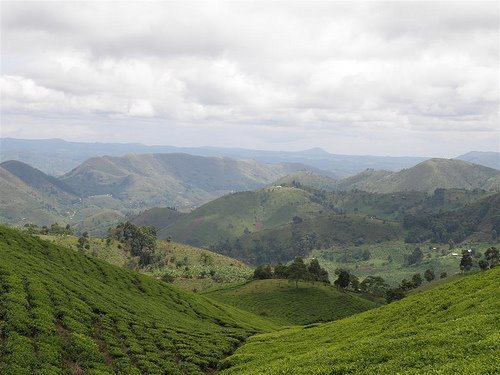
At the moment, the deaf children of the Bushenyi District (over 100) are isolated in their respective schools; most haven’t met their fellow peers at other schools. This is mostly due to lack of money for transportation costs. The Kigarama School has the highest number of deaf children – maybe 25 – and one teacher for the deaf. The others have a few teachers who know a handful of signs, but no one specific teacher. Anyway…so far I’ve been to all five schools in the district: Rugazi, Ruhandagari, Kigarama, Isheyke, and Butare. It takes an entire day to get to the school (most are located hours from town in rural areas), hold the meeting, eat lunch (matooke), and get back home. We usually sit under a tree and go over the simple agenda: sign language lessons and auctioning (the parents bring home-grown vegetables – usually avocado – to the meetings to sell to teachers --this is in lieu of paying Silent Voices membership fees). I had an interpreter b/c many of the parents don’t speak English. The interpreter translated what I said into the local language – for example, I might say, “this is the sign for ‘house’” and the interpreter would say “house” in Runyankore and then I’d give the USL sign for “house” – which happens to be similar to the ASL sign.
Next week I’ll start developing subject-specific curriculum for the deaf classrooms. For example, a math lesson that can be taught in sign language…so the kids are learning new words as well as basic algebra. Natalie will think this is too ambitious, but who cares? These are smart kids!
Photos to come soon!!
At the moment, the deaf children of the Bushenyi District (over 100) are isolated in their respective schools; most haven’t met their fellow peers at other schools. This is mostly due to lack of money for transportation costs. The Kigarama School has the highest number of deaf children – maybe 25 – and one teacher for the deaf. The others have a few teachers who know a handful of signs, but no one specific teacher. Anyway…so far I’ve been to all five schools in the district: Rugazi, Ruhandagari, Kigarama, Isheyke, and Butare. It takes an entire day to get to the school (most are located hours from town in rural areas), hold the meeting, eat lunch (matooke), and get back home. We usually sit under a tree and go over the simple agenda: sign language lessons and auctioning (the parents bring home-grown vegetables – usually avocado – to the meetings to sell to teachers --this is in lieu of paying Silent Voices membership fees). I had an interpreter b/c many of the parents don’t speak English. The interpreter translated what I said into the local language – for example, I might say, “this is the sign for ‘house’” and the interpreter would say “house” in Runyankore and then I’d give the USL sign for “house” – which happens to be similar to the ASL sign.
Next week I’ll start developing subject-specific curriculum for the deaf classrooms. For example, a math lesson that can be taught in sign language…so the kids are learning new words as well as basic algebra. Natalie will think this is too ambitious, but who cares? These are smart kids!
Photos to come soon!!
Subscribe to:
Posts (Atom)